
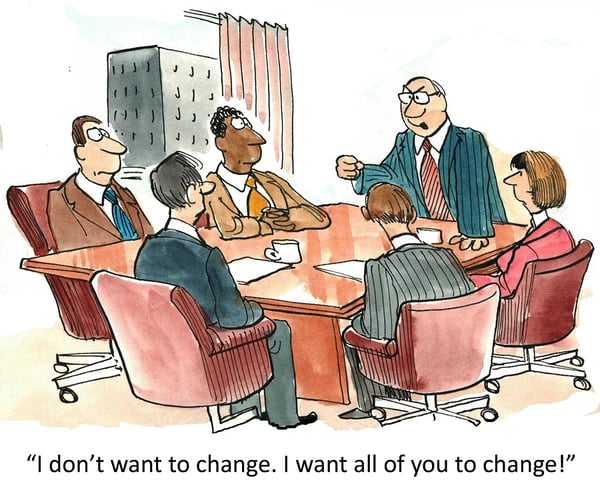
Change is everywhere. New systems. New leaders. New goals. New markets. Yet even when change is needed, many people still say, "Why can’t we just keep things the same?”
Why do people struggle with change at work?
When people search online about change, they are not looking for abstract theories. They are asking practical questions:
- Why do my employees resist change?
- Why is change so hard?
- How do I deal with uncertainty at work?
- How can I lead change without losing my team?
These are real questions. And they matter. Keeping things the same may feel safe, but it often costs more than we think.
And this is where Extended DISC® becomes a powerful tool.
Why Do My Employees Resist Change (and What’s Wrong with Staying the Same)?
Staying the same feels comfortable. People know what to expect, how to do their jobs, and where they fit. But comfort is not the same as growth. When organizations avoid change, several things begin to happen:
- Performance plateaus
If nothing changes, nothing improves. Skills become outdated, processes slow down, and competitors move ahead. - Problems get buried
Leaders delay tough decisions, and issues are ignored instead of being addressed. - Teams become comfortable—and slower
Routines feel safe, but they can reduce agility and responsiveness. - Talent leaves
High performers want growth and new challenges. If they feel stuck, they look elsewhere. - Innovation stops
People stop asking “What if?” and start saying, “That’s how we’ve always done it.” - Fear grows quietly
When change is avoided for too long, small problems turn into bigger ones, making future change more difficult and disruptive.
Over time, staying the same becomes the biggest risk. Stability can be helpful, but stagnation is not. Organizations that succeed don’t change randomly—they change intentionally and bring their people along with them.
Why Is Change So Hard for People?
Change creates uncertainty. And uncertainty triggers stress. When people feel uncertain, they ask:
- Am I safe?
- Will I succeed?
- Do I still belong here?
This reaction is human. It’s not a weakness. But here’s the key: Not everyone reacts to change the same way. That’s where Extended DISC® provides clarity.
How to Deal with Uncertainty at Work: DISC Styles and Change
Extended DISC® identifies four main behavioral styles:
- D–Style (Dominance)
- I–Style (Influence)
- S–Style (Steadiness)
- C–Style (Compliance)
Each style responds to change differently. If you lead change without understanding this, you will lose people. Let’s break it down.
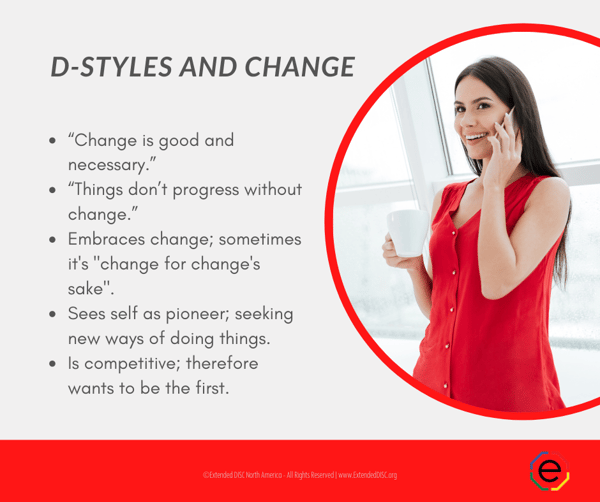
D-styles like change, especially if it moves things forward fast.
- See change as: Opportunity. Speed. Results.
- What frustrates them: Slow decisions. Too much discussion. Emotional resistance.
- What they need during change: Clear goals. Authority to act. Fast updates. Measurable results.
If you slow them down too much, they may push harder — or push people over.
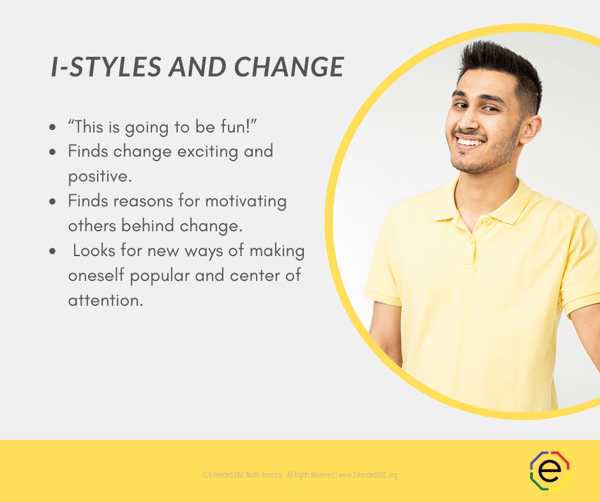
I-style individuals often welcome change if it feels positive and people-focused.
- See change as: Exciting. Social. New possibilities.
- What frustrates them: Silence. Isolation. Negative energy.
- What they need during change: Open communication. Team discussions. Recognition. Optimism.
If change feels cold or technical, they may lose interest.
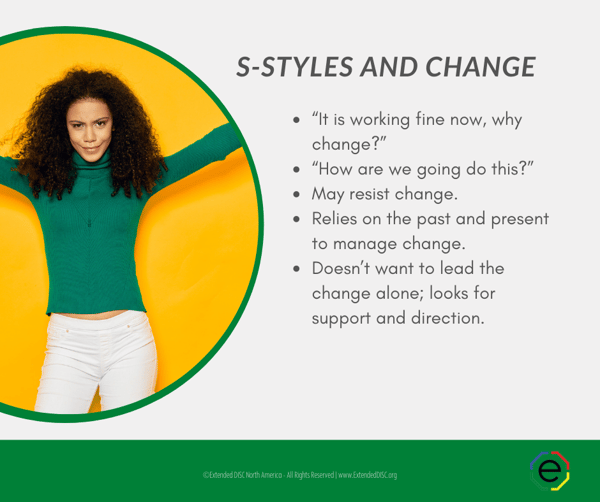
S-style individuals value stability. Sudden change can feel overwhelming.
- See change as: Disruptive. Risky. Stressful.
- What frustrates them: Surprises. Pressure. Fast timelines.
- What they need during change: Time to adjust. Clear step-by-step plans. Reassurance. Personal support.
Ignoring these factors may cause the S-style to quietly resist — or disengage.
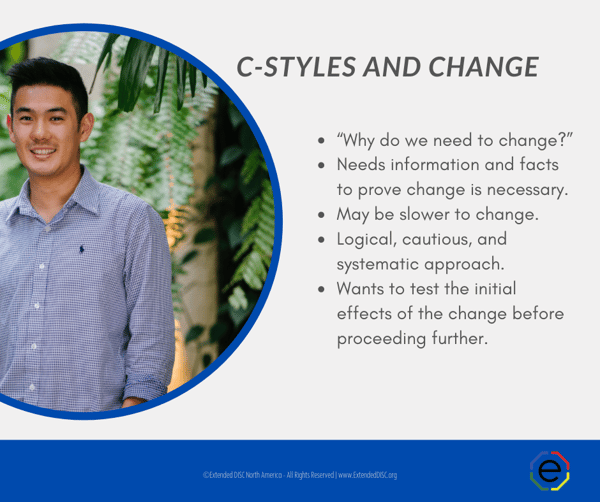
C-style individuals want logic, data, and structure.
- See change as: Questionable. Needs proof.
- What frustrates them: Vague plans. Emotional decisions. Lack of details.
- What they need during change: Clear reasoning. Evidence. Risk analysis—defined processes.
If change feels rushed or poorly thought out, they will push back.
How to Lead Change (and Why One-Size-Fits-All Fails)
Many companies announce change like this: “We are moving in a new direction. Let’s go.”
That may motivate D and I styles. But it may cause S and C styles to feel stress.
The result?
- Mixed reactions
- Friction in teams
- Slow adoption
- Leadership frustration
The problem is not the change. The problem is ignoring behavioral differences.
How Extended DISC® Reduces Resistance to Change
Extended DISC® does not label people as “good” or “bad” with change. It helps you understand:
- Natural strengths
- Stress reactions
- Communication needs
- Leadership impact
When leaders understand behavioral styles, they can:
1. Communicate change differently to different people. Not everyone needs the same message.
2. Predict resistance before it happens. You can see where friction might appear.
3. Support people instead of blaming them. Resistance is often fear, not laziness.
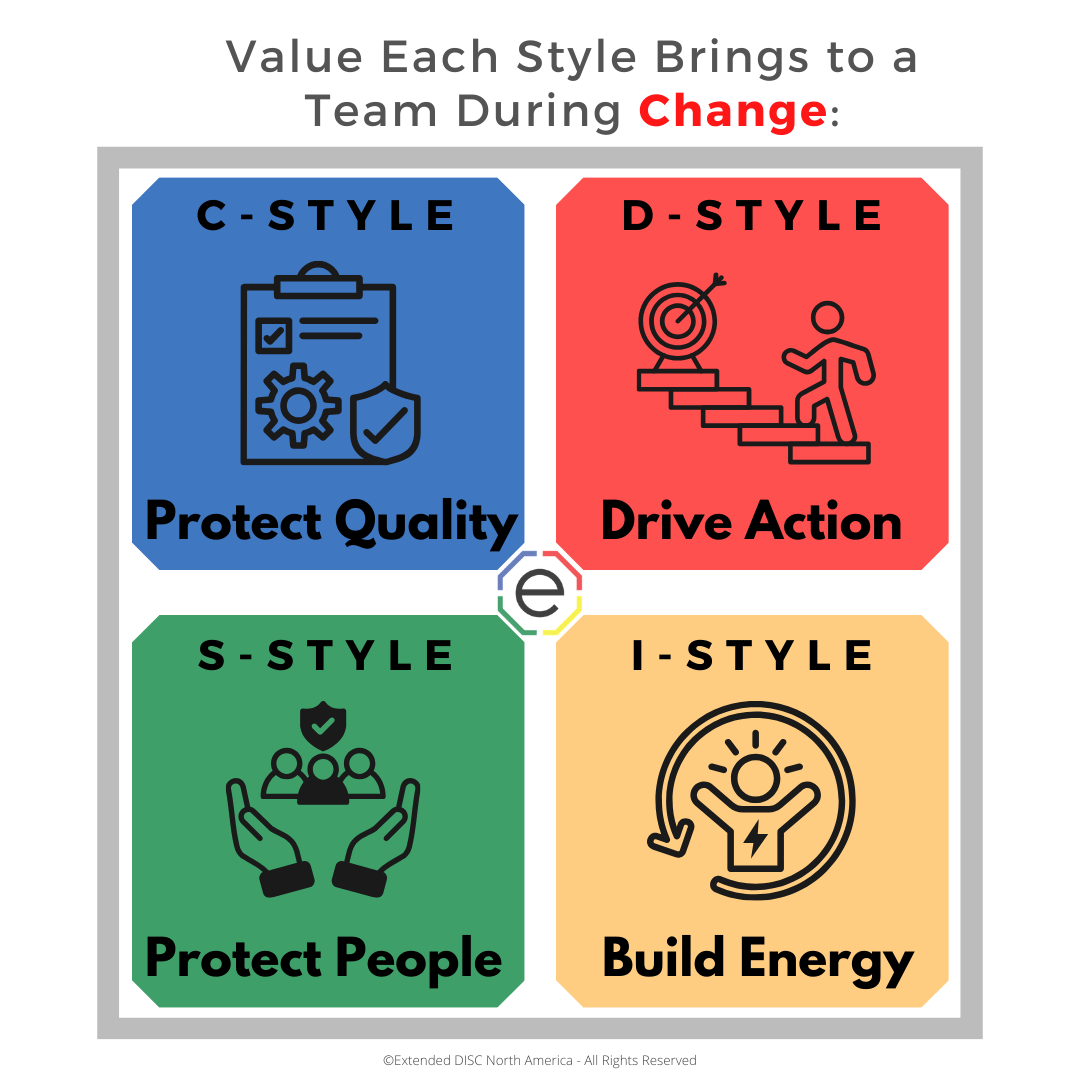
Each style brings value to a team during change:
- D-styles drive action
- I-styles build energy
- S-styles protect people
- C-styles protect quality
That balance is powerful.
Practical Steps to Lead Change with Extended DISC®
If you want change to succeed, start here:
Know Your Own Style: How do you handle uncertainty?
- Do you push forward quickly? (D)
- Do you talk it out with others? (I)
- Do you want time to process? (S)
- Do you analyze every detail? (C)
Leaders often assume others react as they do. That assumption creates blind spots.
Map Your Team’s Behavioral Styles: Use Extended DISC® team reports to understand:
- Who will push for speed?
- Who will need emotional support?
- Who will need data?
- Who will need time?
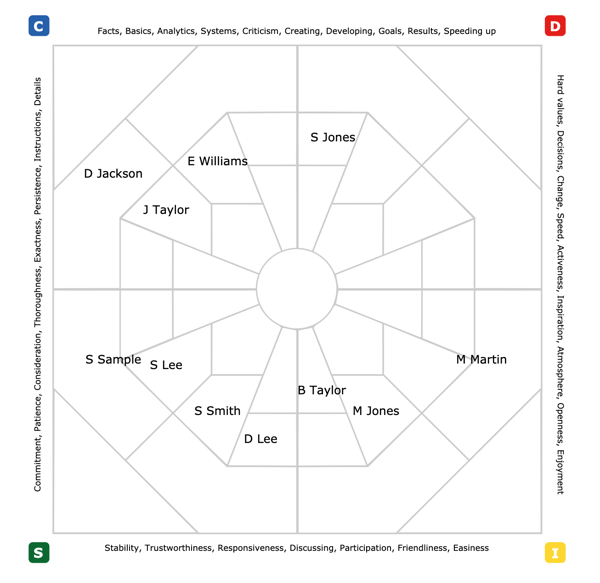
Now you can plan communication with intention.
Adjust Communication by Style: Here’s a simple framework:
- To D-style: “Here’s the goal. Here’s the timeline. You’re leading this part.”
- To I-style: “Here’s the vision. Let’s talk about how this impacts the team.”
- To S-style: “Here’s the plan. We will move step by step. You are supported.”
- To C-style: “Here’s the data. Here’s why this makes sense. Here are the safeguards.”
Same change. Different delivery. That reduces resistance immediately.
Normalize Discomfort: Change is uncomfortable. Say it out loud.
When leaders pretend everything is easy, trust drops. Strong leadership sounds like this: “This will feel uncertain at first. That’s normal. We will work through it together.” That message builds psychological safety.
Conversation Points for Teams
Use these questions to open a discussion:
- What part of this change feels exciting?
- What part feels unclear?
- What information would help you feel more confident?
- What risks should we prepare for?
- What strengths does our team bring to this transition?
These conversations reduce fear and increase ownership.
The Leadership Shift: From Control to Clarity
In uncertain times, leaders often try to control more. But control does not remove uncertainty. Clarity does. Clarity about:
- Expectations
- Roles
- Timelines
- Decision rights
- Support systems
Extended DISC® helps leaders bring clarity to people — not just processes. That difference matters.
What High-Performing Organizations Do Differently
Organizations that manage change well share common traits:
- They invest in behavioral awareness.
- They train leaders in communication styles.
- They anticipate resistance instead of reacting to it.
- They see uncertainty as part of growth — not failure.
Research in organizational psychology shows that companies with high trust and strong communication adapt faster to change. Behavioral awareness strengthens both.
Change Is Not the Enemy — Mismanaged Change Is
Let’s reframe the real issue. Change itself is neutral. It becomes negative when:
- It is unclear.
- It is rushed.
- It ignores people.
- It lacks purpose.
But when change is:
- Intentional,
- Communicated well,
- Supported by behavioral insight,
It becomes a growth engine.
Final Thought: The Cost of Staying the Same
Keeping things the same feels safe. But ask yourself:
- Is our current state producing our best results?
- Are we growing?
- Are we preparing for the future?
- Are we developing our people?
If the answer is no, staying the same is not stability. It’s a slow decline.
Extended DISC® gives leaders a practical way to guide people through uncertainty with awareness, empathy, and structure.
Will you lead change with insight—or react to it under pressure?
That choice makes all the difference. Get started today!