
AI personality tools provide quick results. But when those insights guide real decisions, one question matters: "Can you trust the results?" This is where Extended DISC stands apart.
Organizations are expected to move faster and more efficiently in hiring, developing, and improving employee performance.However, when performance and people are involved, accuracy often matters more than speed. Are you willing to take risks in making the wrong decisions?
How AI Personality Tools are Typically Used

AI tools are built for speed. They create personality insights based on:
- Written responses
- Short questionnaires
- Video or voice analysis
- Online behavior patterns
In many organizations, AI personality insights are built into systems like hiring platforms or talent management tools.
This means they are:
- Created automatically
- Based on surface-level information
- Used early in the process
In theory, they are used because they are easy to access, but they don't have internal evaluation. They provide quick input rather than reliable data. This convenience helps with speed, but it also creates limitations.
Where AI Falls Short
Bias
AI bias is another critical consideration. AI systems learn from existing data, which can include hidden biases related to gender, culture, language, or background. As a result, the outputs may unintentionally reinforce those biases rather than provide objective insight.
In addition, AI does not actually measure personality—it infers patterns based on limited inputs, which can lead to inaccurate or incomplete conclusions about an individual. When organizations make hiring, promotion, or development decisions based on this type of data, they risk acting on flawed assumptions. Over time, this can lead to poor talent decisions, reduced performance, and unintended fairness or compliance issues.
Limited Data
AI tools often use small or readily accessible amounts of information. This makes it difficult to understand long-term behavior, how someone reacts under pressure, or how they act in different situations.
Research shows that AI often relies on surface-level data rather than deeper behavioral understanding. The result is usually a snapshot, not a full picture.
Missing Context
People behave differently depending on their role, team, environment, and stress level.
AI tools usually do not account for these factors in a structured way. This makes it harder to connect results to real job performance.
Inconsistent Results and Reliability
AI results can change based on how questions are asked, the person’s mood, or updated input to the system.
This can make it difficult to compare results or rely on them over time, especially without internal validation.
Prediction vs. Measurement
AI tools try to predict personality without validated algorithms, nor do they go deep or long-term into the data.
Taken together, current research suggests that while AI tools can identify patterns, they still face limitations in consistency, context, and true behavioral measurement.
A Different Approach: Measuring Behavior
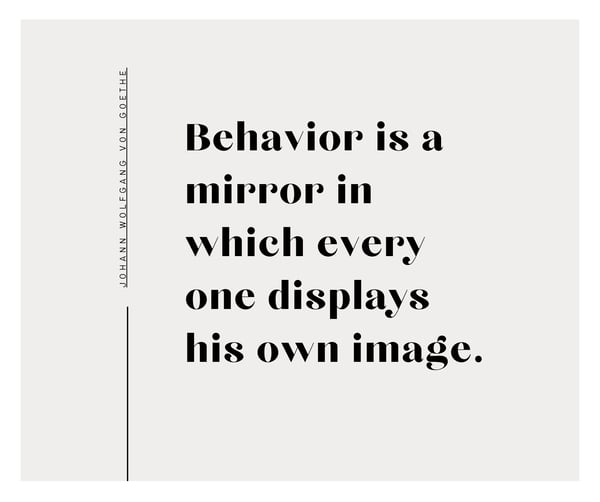 The Extended DISC® Validation Study shows a different method.
Behavior is measured, not guessed.
Extended DISC relies on carefully tested algorithms designed to remain stable over time, produce consistent results, show both natural and adapted behavior, and apply to real job settings. All of this means the results do not change based on small differences in input. The data can be used with confidence.
In addition, Extended DISC® Facilitators are often trained and certified to debrief results. This step helps individuals and teams gain a deeper understanding and apply the information in practical ways.
Why Consistency and Validation Matter
Many AI tools are constantly changing. While this can improve them, it can also make results less consistent.
Extended DISC validates to produce stable scoring, repeatable results, and a clear structure. This allows organizations to compare people fairly, track development over time, match people to roles more accurately, and make better decisions.
These insights can also be applied beyond the individual level. Tools such as Work Pair Analysis and team-based reports help translate individual behavioral data into improved communication, stronger collaboration, and more effective working relationships across roles and teams.
Comparing the Two Approaches
AI Personality Tools
- Fast and easy to use
- Built into many systems
- Helpful for quick insights
- Results may change
- Focus on prediction
Extended DISC® Tools
- Measures natural behavior
- Uses tested and stable methods
- Provides consistent results
- Designed for workplace use
The Impact of Better Data
 When behavioral data is accurate and consistent, it helps organizations hire the right people, develop stronger leaders, build better teams, and improve performance.
Without reliable data, decisions become less certain, even if they appear data-driven.
Final Perspective
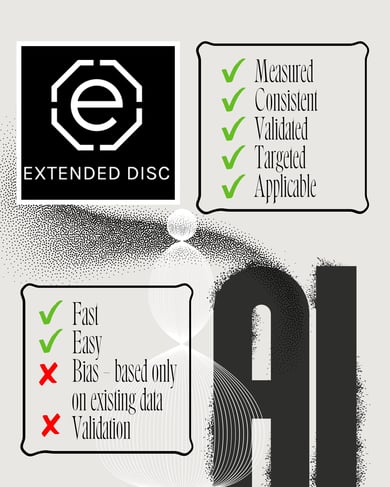 AI personality tools can be useful, especially when speed matters.
But when decisions require accuracy, consistency, and real-world application, the method behind the data becomes critical.
AI tools provide quick direction.
DISC provides reliable behavioral insight.
Closing Thought
 The goal is not just to understand people. It's to make better decisions about them and provide feedback that supports their success.
That requires clear, consistent, and proven measurement of behavior.
For those evaluating tools or approaches, it may be worth taking a closer look at how behavioral data is generated, validated, and applied in practice—and whether it holds up over time.